Populica vs Jasper: Marketing Copy Generation vs. Full Campaign Research
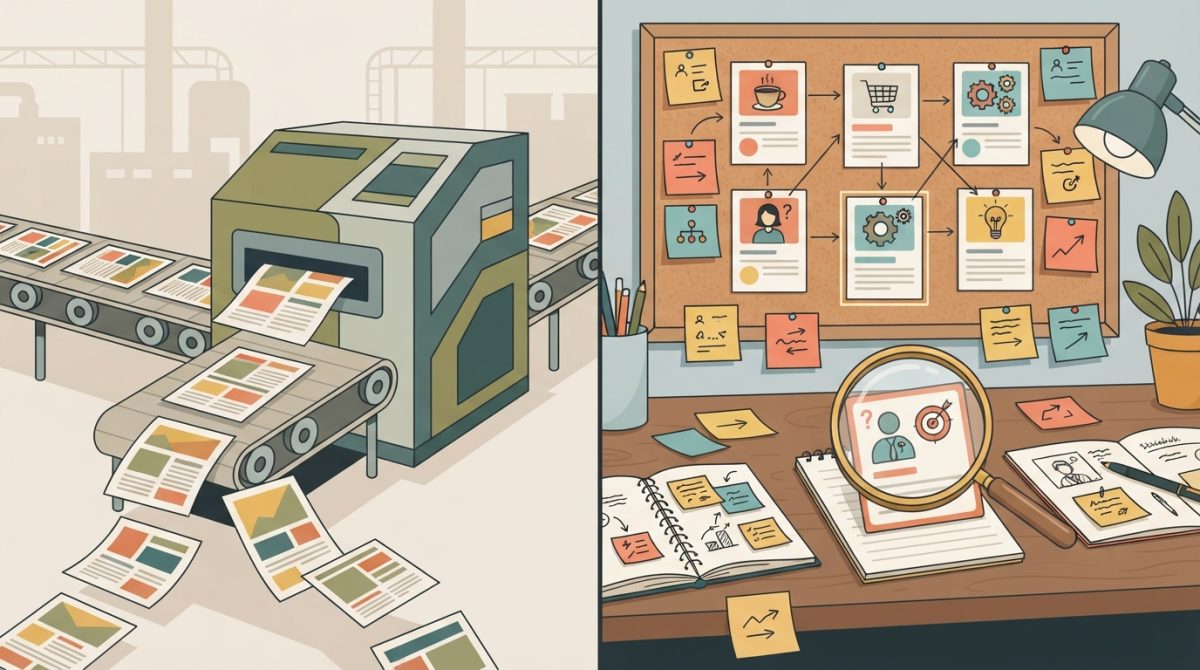
Populica vs Jasper comes down to which job is unfinished: Jasper is an AI content platform that produces on-brand marketing copy at volume from context your team already has, while Populica researches who the buyer is and turns that research into a campaign brief, ad creative and a launch document. Pick Jasper for production, Populica for research.
Populica is a campaign research and creative tool for small marketing teams and agencies: it takes a company's name, website and sector, researches 8 to 16 buyer personas specific to that company, and carries them through a six-step campaign studio that ends in ad creative and an exportable launch document. Jasper describes itself with the line "Put AI agents to work for marketing" (jasper.ai, accessed September 2026), and its product is built around agents, content pipelines, a brand voice, a knowledge base and governance controls. The two tools overlap less than their category labels suggest, so this comparison is organised by the job each one does, where each one is stronger, and what each one costs today.
What is Jasper built for?
Jasper is built for marketing teams that already know their audience and need to produce a lot of on-brand content without it drifting in tone or accuracy. The Jasper homepage lists agents that execute marketing work, content pipelines that move work from idea to launch, a Canvas workspace, Grid for systematic content creation at scale, image pipelines, a knowledge base, Style Guide governance, APIs and an MCP connector that passes brand context to other AI tools (jasper.ai, accessed September 2026). Every one of those capabilities assumes the team can feed Jasper good context: a brand voice, source documents, product facts and audience definitions. Jasper's own pricing page treats audiences as an asset the team stores, next to brand voices and knowledge assets, which means the quality of the output depends directly on how well the team already understands the buyer before Jasper writes a word.
What is Populica built for?
Populica is built for the step before production, when a team or agency has a company to market but no reliable picture of who buys from it or what stops them. Populica starts from the company's name, website and sector, researches 8 to 16 buyer personas with their situation and objections, and then walks the campaign through six steps: setup, audiences, strategy, creative, channels and a print-ready launch document with budget flow, KPI targets and channel mix (populica.com/pricing.md, accessed September 2026). Populica also generates on-brand ad creative per persona and offers persona chat, where the team can question a generated buyer to pressure-test messaging. Populica does not replace a content production platform: there is no equivalent of Jasper's content pipelines, APIs or enterprise governance, and Populica is not the right tool for producing a month of blog posts or email sequences.
Want to see the research half before you decide? Enter your company name and sector and get three researched personas, each with the objection that stops them buying. No account needed.
Draft my audience free →Populica vs Jasper: side-by-side comparison
The table below compares Populica and Jasper on the criteria that decide which one a small team or agency should pay for, including the rows where Jasper is clearly the stronger tool. Pricing was checked on each vendor's own pricing page in September 2026.
| Jasper | Populica | |
|---|---|---|
| Main job | Producing on-brand marketing content at volume | Researching the buyer and building one campaign from that research |
| Where the audience comes from | Your team defines and stores it (3 audiences on Pro) | Researched from the company's website and sector, 8 to 16 personas per run |
| Content volume and pipelines | Stronger: agents, content pipelines, Grid, image pipelines | Limited to ad creative per persona and a launch document |
| Brand governance | Stronger: brand voice, Style Guide, governance controls | Brand colors and on-brand creative, no governance layer |
| Integrations and API | Stronger: APIs and an MCP connector | None published |
| Campaign strategy and launch plan | Not the core product | Six-step studio ending in a launch document with budget flow and KPIs |
| Free option | No free plan listed, 7-day trial on Pro | Free plan: 1 company, 1 research run, 10 creative drafts a month |
| Entry price | Pro $69 per seat per month, $59 billed annually | Starter $19 per month, Pro $49, Agency $129 with unlimited companies |
| Pricing unit | Per seat; Business is custom with a 12-month minimum | Per account, tiered by companies, research runs and drafts |
The honest reading of the Populica vs Jasper table is that Jasper wins every row about producing and governing content at scale, and Populica wins the rows about knowing who the content is for. Jasper Pro at $69 per seat per month includes 1 seat, 2 brand voices, 5 knowledge assets and 3 audiences, with a 7-day free trial, while Jasper Business has custom pricing, unlimited brand assets and a 12-month minimum commitment (jasper.ai/pricing, accessed September 2026). Populica's plans run from Free to Agency at $129 per month for unlimited companies and research runs (populica.com/pricing.md, accessed September 2026). The price gap matters less than the job gap: a cheaper tool that does the wrong job is still the wrong tool.
Why does Jasper output still come out generic for some teams?
Jasper output comes out generic for some teams because a language model can only use the context it is given, and a content platform, however capable, writes from whatever audience knowledge the team loads into it. When the stored audience says "marketing managers at mid-size companies", Jasper produces well formatted, on-brand copy for the average marketing manager, which is also what every competitor using the same category description receives. The brand voice and the prompt templates supply method, meaning tone, format and structure, but they cannot supply knowledge the team never wrote down, such as the objection that stalls this particular buyer or the proof the brand can truthfully claim. Our explainer on why AI-written ad copy comes out generic walks through that mechanism, and the same logic applies to Jasper, ChatGPT or any other writing tool.
A researched brief fixes that gap in any tool, which is why the question for a Jasper customer is rarely "should we replace Jasper" and more often "where does our audience knowledge come from". A campaign brief survives a change of model or platform, because it is plain language about a buyer rather than instructions tuned to one product, and it makes AI output reviewable against a named objection instead of against taste. Teams that already pay for Jasper can research the audience in Populica, then paste the personas and objections into Jasper's audience and knowledge assets so that every Jasper pipeline starts from a specific buyer. Teams still weighing whether to keep Jasper at all can read our breakdown of Jasper alternatives grouped by what they actually replace before their renewal date.
Which should a small agency choose, Jasper or Populica?
A small agency should choose based on where its time is actually lost. If the agency already knows each client's buyers well and the bottleneck is producing blog posts, emails and social copy on-brand across many clients, Jasper solves that problem and Populica does not, and paying for Jasper seats is the sensible call. If the agency keeps starting client campaigns from a one-line audience description, spends kickoff meetings guessing at personas and ships creative that could belong to any competitor, the bottleneck is research, and Jasper will produce that generic creative faster rather than better. Many agencies need both jobs done, in which case the order matters: research the buyer first, then produce at volume. For the research workflow itself, our guide on giving every client real audience research as a small agency covers the process step by step.
Populica's Free plan covers one company with one audience research run and 10 AI creative drafts a month, no credit card required. Research the buyer, get the brief, then take it into whatever writing tool your team already uses.
Start free →Frequently asked questions
Is Populica a Jasper alternative?
Populica is a Jasper alternative only if the problem is not knowing who the buyer is. Populica researches buyer personas from a company's website and sector and builds one campaign from them, with ad creative and a launch document. Jasper is an AI content platform for producing on-brand marketing content at volume. If the bottleneck is content production, Jasper is the stronger tool.
How much does Jasper cost compared with Populica?
Jasper Pro costs $69 per seat per month on monthly billing or $59 per seat per month billed annually, with a 7-day free trial and no free plan listed; Jasper Business is custom priced with a 12-month minimum (jasper.ai/pricing, accessed September 2026). Populica has a Free plan, Starter at $19 per month, Pro at $49 and Agency at $129 with unlimited companies (populica.com/pricing.md, accessed September 2026).
Can I use Populica and Jasper together?
Yes. A practical workflow is to run the audience research in Populica, then copy the personas, objections and usable proof into Jasper's audience and knowledge assets. Jasper then produces content at volume from a researched buyer instead of a one-line category description.
Does Jasper do audience research?
Jasper's pricing page lists audiences as an asset a team stores, with 3 audiences on the Pro plan and unlimited on Business, next to brand voices and knowledge assets. Those audiences are defined by the team. Populica is built to research the audience itself from the company's name, website and sector.
Which tool is better for a small marketing agency?
The better tool depends on where the agency loses time. Agencies that know their clients' buyers and need more on-brand content across many clients get more from Jasper. Agencies that start each campaign from guesswork about the buyer get more from Populica, whose Agency plan covers unlimited companies and research runs for $129 per month.
Why does AI copy from Jasper or ChatGPT sometimes sound generic?
AI copy sounds generic when the model receives only a category description of the buyer, because it then writes the most typical answer for that category. Brand voice settings and prompt templates control tone and format, but they cannot add buyer knowledge the team never supplied. A researched brief with the buyer's situation and objection is what makes the output specific.
Keep reading
Campaign Brief vs Prompt Template: What Each One Can and Cannot Give an AI
A prompt template gives an AI method: format, steps and checks. A campaign brief gives it knowledge: this buyer, this objection, this proof. Here is what each one can and cannot do, the swap test that tells them apart, and how to layer them in one prompt.
Jasper Alternatives for Marketers Who Need Research, Not Just Copy
Most Jasper alternative lists compare writing tools to other writing tools. If your complaint is that the output reads like anyone could have written it, the replacement you need is research, not a cheaper seat. Verified September 2026 pricing.
SparkToro Alternatives for Audience Research on a Small Budget
No cheap tool reproduces SparkToro's dataset, so the real question is which part of SparkToro you were using. A verified price comparison, and the part of audience research that costs nothing.