How a Small Agency Can Give Every Client Real Audience Research
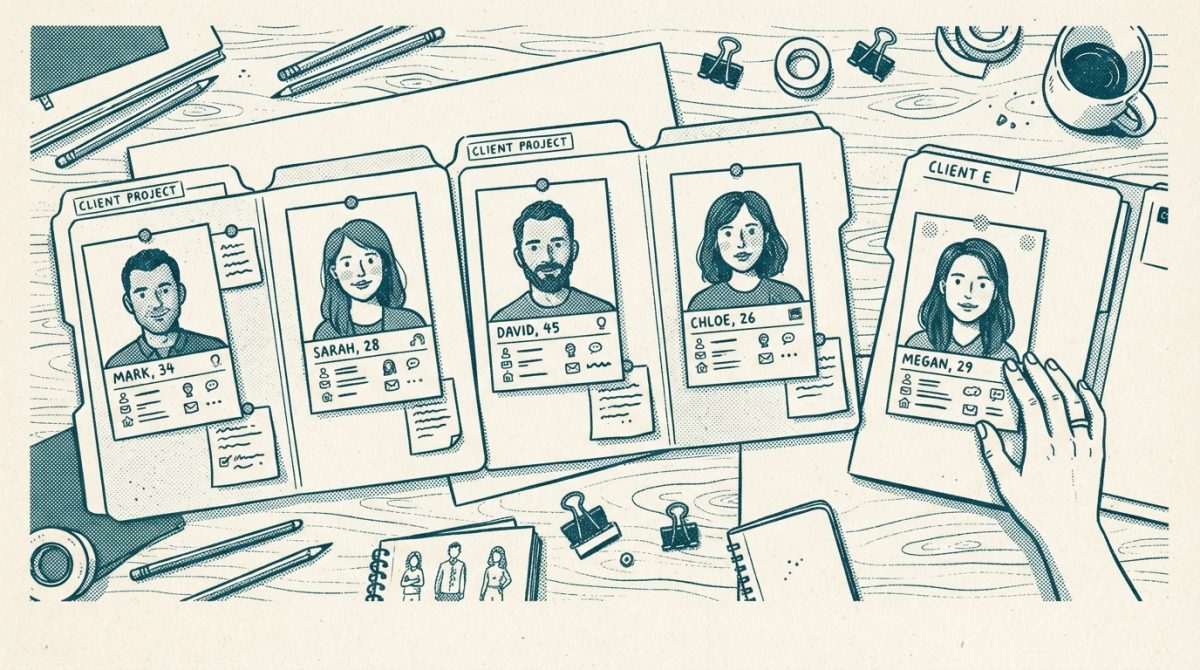
A small agency can give every client real audience research by making it a fixed onboarding step with two parts: a desk research pass that drafts the client's likely buyers and the objection that stops each one, and a short validation pass where the client's own people and data confirm or reject those drafts before any campaign is written.
The reason most small agencies do not do this is not that they doubt its value. It is that research is the only step in a campaign with no deadline of its own, so it is the one that gets squeezed when the pitch is on Thursday. The fix is structural, not motivational: research has to become cheap enough and routine enough that skipping it is more work than doing it.
This guide is from Populica, a tool that drafts researched buyer personas for a company from its name, website and sector, and turns them into a campaign brief and ad creative. The process below works with or without it.
Why audience research is the first thing a small agency cuts
Three pressures push it out, and they compound.
- Nobody pays for it as a line item. Clients will pay for ads, for a website, for a launch. Research sold separately reads as an optional extra, so it gets negotiated away in the proposal.
- It has no natural owner. The strategist assumes the account lead talked to the client, the account lead assumes the strategist has it covered, and the designer starts from the logo.
- It is slow when done from scratch. Reading a client's site, reviews, competitors and sales material for every new account takes days, and a two person agency does not have days per client.
What replaces research in practice is a set of personas written from memory the night before, usually some version of "busy decision maker, values quality, short on time". Those personas describe almost every buyer in every category, which is exactly why they never change a single creative decision.
What counts as real audience research, and what does not
"Real" does not have to mean a survey panel. For a small agency, it means research whose conclusions are specific to this client and could be wrong. If a persona could be pasted into a different client's deck without edits, it is not research.
| Personas from memory | Researched hypothesis (desk pass) | Measured audience research | |
|---|---|---|---|
| Source | The team's assumptions | The client's site, offer, sector, competitors and public signals | Behavioral or survey data from real people |
| Specific to this client | Rarely | Yes, and it names the objection per buyer | Yes |
| Time per client | An hour, the night before | Minutes to a few hours, depending on tooling | Weeks, and a real budget |
| What it can prove | Nothing | Nothing on its own: it is a hypothesis to validate | Where the audience actually is and what it actually does |
| Where it wins | Speed, and nothing else | Every client can have it, on every engagement | Media planning, sponsorships, large budgets where a wrong guess is expensive |
The middle column is what a small agency can realistically deliver to every client. It is honest about being a hypothesis, which is also what makes it useful: a hypothesis can be checked with the client in half an hour. The right column is still worth paying for on specific engagements, and our comparison of SparkToro alternatives for audience research on a small budget covers when a measurement tool earns its monthly fee.
A repeatable research process for every client
The goal is a process that runs the same way on the tenth client as on the first, so it survives busy weeks.
- Collect what the client already has. Website, sales deck, the last few proposals they won, public reviews, and any notes from sales calls. Ask for these in the onboarding email, not in a later meeting.
- Run the desk pass. Draft six to ten candidate buyers, each with the job they are trying to get done, what they believe today, and the one objection most likely to stop them buying. Do this by hand, with a general AI assistant fed those materials, or with a dedicated tool.
- Validate with the people who sell. A thirty minute call where the client's sales or front desk team reads the drafts and says "we see this one every week", "never met this person", or "you missed someone". This call does more than the desk pass itself.
- Check against one real signal. Review wording, support tickets, search queries from the client's own analytics, or past ad results. One source is enough to catch a persona the team invented.
- Keep two to four audiences and write them into the brief. The survivors, with their objections, become the audience section of the campaign brief that every ad is checked against.
- Revisit after the first results. When the first campaign reports back, mark which audience responded and which did not, and update the set. Research that never gets revised turns back into memory within a year.
If a client is new and has no customer data at all, steps 3 and 4 get harder but not impossible. Our guide to building buyer personas when you have zero customer data covers what to validate against instead.
Want to see what a desk pass looks like for one of your clients? Enter the client's company name and sector and get three researched personas, each with the objection that stops them buying. No account needed.
Draft a client's audience free →Why client research beats a better prompt template
Many agencies now run AI drafting across every account, often with a carefully built prompt template or saved skill. That template is worth having, but it encodes method: how to structure an ad, what a good hook looks like, which formats to test. It is identical for every client by design, and identical for every other agency that uses the same one.
A language model can only use what is in its context. If the context for client A and client B is the same template plus a different company name, the output for both will sit at the same generic centre of their categories. The only input that makes the output specific to one client is knowledge about that client's buyers: who they are, what they already believe, what stops them. That is the research, written down as a brief. We cover the difference in more detail in what a campaign brief is and why small teams skip it.
For an agency this has a commercial edge too. The template is something any competitor can copy tomorrow. A research file per client, revised after every campaign, is not, and it is the part of the work that keeps accumulating value the longer the client stays.
How to package research so it stops getting cut
- Put it inside onboarding, not in the price list. If research is a line item, it can be removed. If it is how every engagement starts, it is not negotiable, and the client sees it as part of how you work.
- Show the output in the first week. A short document with the candidate audiences and their objections gives the client something concrete to react to before a single ad is designed, which is also the easiest moment to catch a wrong assumption.
- Keep one file per client. Audiences, objections, constraints and what the last campaign taught you, in one place. It is what lets a freelancer or a new hire pick up the account without restarting the thinking.
- Be clear about what it is. Call the desk pass a researched hypothesis, validated with the client's team. Do not present it as market research. Clients trust the process more when you are precise about its limits.
We wrote more about running this across a roster of clients on our page for agencies, including what the product does and does not do today.
Populica's Free plan covers one company with one research run and ten creative drafts a month, no credit card. The Agency plan is $129 a month with unlimited client companies, research runs and drafts.
Start free with one client →Frequently asked questions
How long should audience research take per client for a small agency?
The desk pass can take anywhere from minutes with a dedicated tool to a few hours by hand. The validation call with the client's sales or front desk team should be about thirty minutes. If the whole step takes more than a day per client, it will get skipped in busy weeks, so design it to fit inside onboarding.
Is AI-generated persona research real market research?
No. An AI research pass over a client's website, offer and sector produces a researched hypothesis: specific, useful and checkable, but not measured. It becomes reliable when the client's own team validates it and it is checked against at least one real signal such as reviews, support tickets or past ad results.
Should an agency charge separately for audience research?
It usually works better as a fixed part of onboarding than as an optional line item. Optional line items get negotiated away, and a campaign built without research is harder to defend when results come in. Including it in how every engagement starts keeps it from being cut.
When is it worth paying for a measured audience research tool?
When the engagement depends on knowing where an audience actually spends time, such as media planning, sponsorships or podcast buys, or when the budget is large enough that a wrong guess is expensive. Tools that measure real audience behavior answer that question; a persona generator does not.
How many audiences should a small agency keep per client?
Two to four is a practical range. Draft six to ten candidates, validate them with the client, and keep the ones the client's team recognises and that show up in at least one real signal. More than four usually means the campaign is not making a choice.
Can clients see that the research came from Populica?
Populica's launch document exports without Populica branding on the content, so an agency can present the thinking as its own work. There is no custom domain or logo replacement in the product today, so it is not a full white label.
Keep reading
Why AI-Written Ad Copy Comes Out Generic (It Is Not the Model)
Generic AI ad copy is almost always an input problem. A language model can only use what is in its context, and a thin prompt gets the average ad for the category. What to add, in what order, and why a better template is not enough.
What Is a Campaign Brief, and Why Most Small Teams Skip Writing One
Most small teams skip the brief because it feels like paperwork. It is now also the single biggest lever on the quality of anything an AI drafts for you, and a prompt template cannot replace it.
How to Build Buyer Personas When You Have Zero Customer Data
Most "buyer persona" templates assume you already have customers to interview. Here is what to do when you do not.