How to Write Ad Creative That Isn't Generic Stock-Photo Marketing
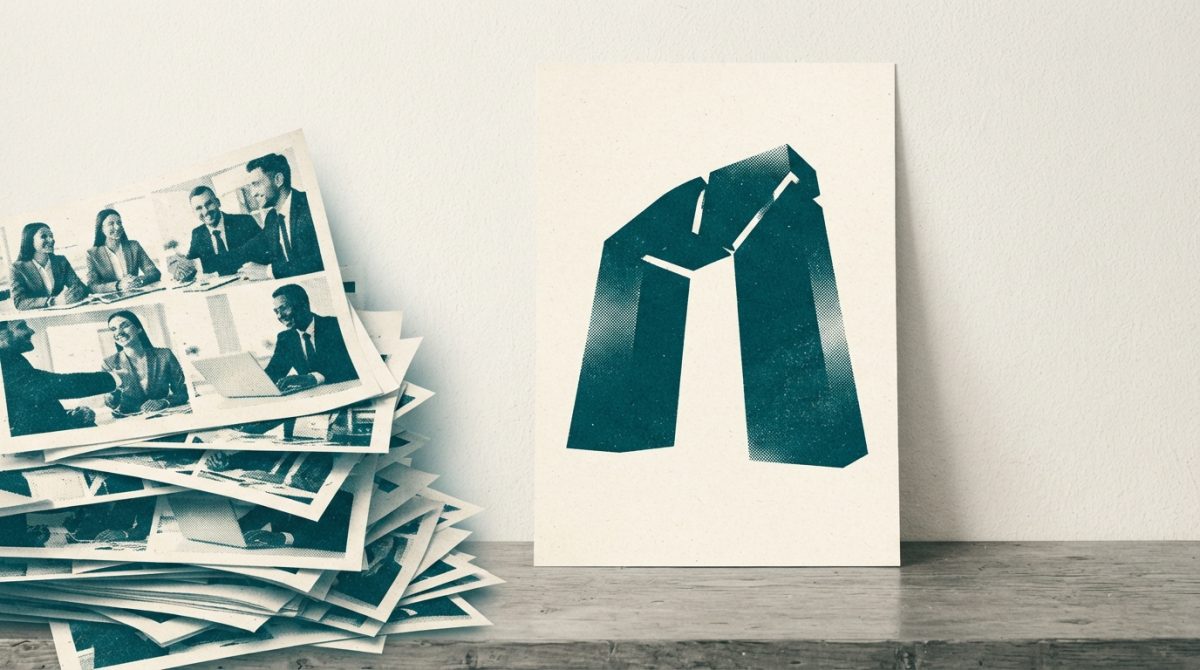
To write ad creative that does not look like generic stock-photo marketing, start from one specific buyer and the objection that stops them, write the headline first, and only then choose a single visual idea that finishes the headline's thought instead of decorating it. Generic creative almost always comes from picking the image first.
Stock-photo marketing is easy to recognise: a smiling team around a laptop, a handshake across a desk, a person pointing at a floating chart. None of those images is wrong on its own, but none of them says anything about the product, the buyer or the reason to act, so the eye slides straight past. This guide is from Populica, a tool that researches buyer personas for a company from its name, website and sector and turns them into a campaign brief and on-brand ad creative. The method below works just as well with a designer, a photographer, a template editor or an image model.
Why does ad creative end up looking like stock photography?
Ad creative ends up looking like stock photography when the visual is chosen before anyone has decided what the ad is trying to say. A designer or an image model asked for "an image for a marketing agency ad" can only return the picture most associated with marketing agencies in general, and that picture already exists in thousands of library collections: laptops, meeting rooms, sticky notes, confident people in open offices. AI image tools behave the same way. A prompt that describes a category produces the average picture of that category, for the same reason a thin copy prompt produces the average ad, which we unpack in our guide to why AI-written ad copy comes out generic. The fix sits upstream of the image, in what you know about the buyer.
Stock creative also fails a simpler test: it could run for a competitor without changing a single pixel. If an image works equally well for every company in the category, it carries no information about yours, and a viewer scrolling a feed at speed has no reason to stop on it. A specific image does the opposite. When the visual only makes sense next to your headline and your buyer's problem, the viewer has to read the line to understand the picture, and that small moment of effort is what turns a scroll into attention. Specificity is the whole job of an ad image, not a stylistic preference that a brand can take or leave.
Stock photo, generic AI image or concept creative: what is the difference?
Small teams usually choose between three kinds of creative. Each one wins somewhere.
| Stock photo | Generic AI image | Concept creative | |
|---|---|---|---|
| Where the image comes from | A library search on a category keyword | An image model prompted with the category | One idea built from the headline and the buyer's problem |
| Same for a competitor? | Often, royalty-free photos are licensed non-exclusively | Usually, similar prompts return similar pictures | No, the idea depends on your buyer and your claim |
| Says anything about the offer? | Rarely | Rarely | Yes, it shows the problem or the promise |
| Where it wins | Blog headers, team pages, backgrounds: cheap, fast and safe | Quick iterations, any size, no licence search | Paid social and display, where the image has to stop a scroll |
| Main risk | Invisible in a feed, and a rival may run the same photo | The same invisibility plus an artificial look | More thinking up front, and a clever image cannot rescue a weak headline |
The honest reading of the table is that stock photography is not the enemy everywhere. For a blog header, a team page or a background texture, a good library photo is quick, properly licensed and perfectly adequate. The problem is using stock where the image has to earn attention, which describes almost every paid placement. Generic AI images share the same weakness and add another, because a category prompt returns the category average with the overly smooth finish that can read as machine made. Concept creative costs more thinking before the first draft, and that thinking is exactly the step the other two options let a team skip.
Want the buyer and the objection before you brief a single visual? Enter your company name and sector and get three researched personas, each with the objection that stops them buying. No account needed.
Draft my audience free →How do you write ad creative that isn't generic, step by step?
The order matters more than the tool. Each step below takes minutes and removes one reason the creative could come out generic.
- Name one buyer in one situation. Not "small business owners" but the owner of a twelve-person restaurant who does the books on Sunday nights. A specific person gives the image a specific scene to show.
- Write down the objection. The single most likely reason that buyer scrolls past, such as "switching will take weeks". Strong creative either shows the objection being answered or makes the cost of ignoring it visible.
- Write the headline before the image. The headline carries the claim. The image exists to make that claim land faster, so it cannot be chosen until the claim exists.
- Find the visual that completes the headline. Ask what a viewer would need to see for the line to hit harder: the problem made physical, an exaggerated scale, the moment after the promise is kept, or an object from the buyer's actual day.
- Keep one idea per ad. One focal point, one message. A second idea splits attention and usually ends up as decoration.
- Run the swap test. Put a competitor's logo on the ad. If the ad still works unchanged, the creative is generic and needs a more specific idea.
- Check it at feed size. Look at the ad as a thumbnail on a phone. If the idea does not read in about a second at that size, simplify it.
Steps one and two are where most teams stall, and the reason is usually that nobody has written down who the buyer actually is. Without that sentence, every later step falls back to the category, and the category is where stock imagery lives. If you are working on a new account or a brand with no customer data yet, our guide to building buyer personas when you have zero customer data shows how to draft a credible first version honestly, labelled as a hypothesis to test rather than presented as research you never did. Even a rough, clearly marked persona gives the image something concrete to show.
What should an ad image actually show?
An ad image should show something only your buyer would recognise as their own situation, tied directly to the headline. Four patterns work reliably across categories. The problem made physical: a restaurant owner's week of receipts drawn as a pile that fills the frame. Exaggerated scale: the one annoying task shown enormous, or the product shown tiny next to the job it replaces. The moment after the promise: the empty inbox, the Sunday night with the laptop closed. And the object from the buyer's day: the clipboard, the delivery van, the phone full of missed calls, shot plainly and close. Each of these is an idea first and a picture second, which is why it survives any production method, from a phone photo to an illustration to an image model.
A short banned list is just as useful as a list of patterns. Write down the images the brand will not use in paid creative, and share the list with whoever makes the ads, including any AI tool. Populica's ad creative generator works from the same rules: its image instructions ask for a visual that completes the headline with a single concept, and they explicitly exclude stock clichés such as a person smiling at a laptop, a generic office, a handshake or a floating dashboard. The banned list does not make the creative good by itself. What it does is block the easiest wrong answer, which forces whoever is making the ad, human or model, to go looking for a real idea instead.
Why does the brief matter more than the image tool?
A design template, a prompt formula or an image-generation skill gives you method: bold colour, one focal point, rule of thirds, a strong call to action in the lower third. Method is useful, but it is identical for you and for every competitor using the same tool, so it cannot make your creative different from theirs. A campaign brief gives you knowledge instead: this buyer, this objection, this proof, these words the brand never uses. That knowledge is precisely what a template cannot contain, because it does not exist anywhere outside your business. Generic creative is rarely the fault of the tool or the model. It is what any tool produces when the input holds no specific knowledge about the buyer.
The brief is also the part of the process that lasts. Image models change every few months and design tools come and go, but a written brief carries across all of them, makes every draft reviewable against something concrete, and improves each time a campaign teaches you what worked. Our explainer on what a campaign brief is and why most small teams skip writing one covers the full structure, including the audience and objection sections that feed the creative directly. If you are comparing creative tools right now, our look at AdCreative.ai alternatives separates the tools that generate volume from the ones that help with the input.
Populica turns researched personas into a campaign brief and ad creative written for each one. The Free plan includes 1 company, 1 audience research run and 10 AI creative drafts a month, with no credit card required.
Start free →Frequently asked questions
Is it bad to use stock photos in ads?
Not always. Stock photos are fine for blog headers, team pages and backgrounds, where the image does not have to earn attention. They work poorly in paid social and display ads because royalty-free photos are licensed non-exclusively, say nothing specific about your offer, and could run unchanged in a competitor's ad.
Can AI image generators make ad creative that does not look generic?
Yes, when the prompt carries a concept rather than a category. Asking for 'an image for a bookkeeping ad' returns the average bookkeeping picture. Describing one buyer, the headline and a single visual idea that completes it, plus a list of banned cliches, gives the model something specific to draw.
What is the swap test for ad creative?
Put a competitor's logo on your ad and look at it again. If the image and headline still work without any change, the creative is generic because it says nothing only your brand can say. Specific creative breaks when you swap the logo, because the idea is tied to your buyer and your claim.
Should I write the headline or choose the image first?
Write the headline first. The headline carries the claim and the image exists to make that claim land faster, so the image cannot be chosen well until the claim exists. Picking the image first is the most common route to stock-photo creative, because without a claim the only brief left is the category.
How many ideas should one ad image contain?
One. A single focal point and a single message read in about a second at feed size on a phone. A second idea splits attention, and it usually ends up as decoration that makes the ad look busier without making it clearer. If you have two ideas, make two ads and test them.
What if my brand has no photography of its own?
Use ideas that do not depend on a photo shoot: a concept illustration, a type-led design where the headline is the visual, or a plain close-up of an object from the buyer's day shot on a phone. The idea matters more than the production value, so a simple image of the right thing beats a polished image of the wrong one.
Keep reading
Why AI-Written Ad Copy Comes Out Generic (It Is Not the Model)
Generic AI ad copy is almost always an input problem. A language model can only use what is in its context, and a thin prompt gets the average ad for the category. What to add, in what order, and why a better template is not enough.
How a Small Agency Can Give Every Client Real Audience Research
Audience research is the step small agencies cut first. Here is a repeatable process that makes it a fixed part of onboarding for every client, what counts as real research and what does not, and where a measurement tool is still worth paying for.
What Is a Campaign Brief, and Why Most Small Teams Skip Writing One
Most small teams skip the brief because it feels like paperwork. It is now also the single biggest lever on the quality of anything an AI drafts for you, and a prompt template cannot replace it.